
TECHNICAL DATA SHEET

Amstrad (Alan Michael Sugar TRADing) revolutionized European computing in the 1980s by applying a low-cost, all-in-one philosophy. Its strategy consisted of using injection-molded plastic casings and mass-manufacturing in the Far East, allowing them to offer complete systems (computer, monitor, and storage unit) at a fraction of their competitors' prices.
Amstrad, which was a consumer electronics manufacturer in the 1970s, led the market with its low-cost products. These were made using injection-molded plastic, which reduced costs compared to the competition. Due to the great boom of its products, the company expanded rapidly in the market, issuing shares on the London Stock Exchange. In the following years, it doubled its annual size and began marketing its own personal computers with the aim of leading the market with low costs and challenging competitors' high-priced personal computers.
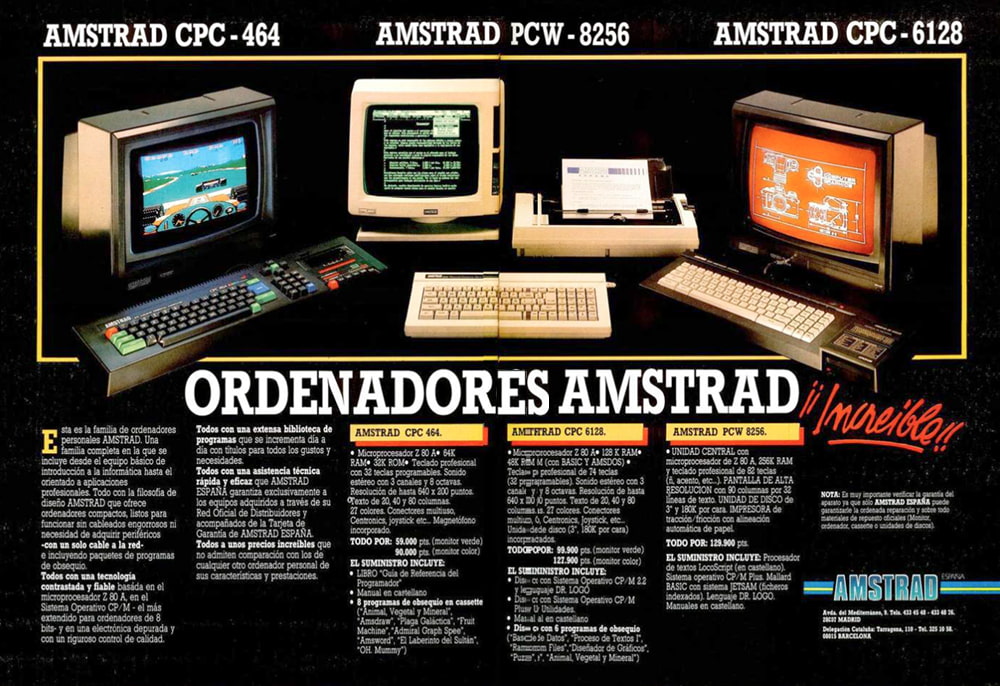
In 1984, it launched the CPC 464 to capture the market from its competitors, Commodore and Sinclair. It was the first computer in the Amstrad series based on a Zilog Z80 processor with 64 KB of RAM, including a tape drive and a green phosphor or color monitor. This range was launched in the UK, France, Australia, Germany, and Spain, where it was a sales success.
It was followed by the CPC 664 models with the first 3" disk drive, and the CPC 6128 with 128 KB of RAM and a more professional keyboard. Variants like the CPC Plus followed, as well as the PCW 8256 in 1985, which was marketed as a word processor, taking the market by storm and competing against high-cost computers. It was preceded by the PC1512 with the MS-DOS operating system in 1986, and a year later, the PCW 8512 launched in 1987. In 1988, the first laptop in the Amstrad series was released, the PPC512/640.
By the early 1990s, Amstrad began to focus more on laptops than desktop computers. After several failed launches such as the GX4000—a video console that failed due to its 8-bit architecture against the 16-bit systems of the time—and the PenPad, an unsuccessful PDA, the company returned to releasing various electronic equipment like Hi-Fi systems and 14" TVs that included a VHS video player with two units. They decided to focus more on communications and less on computers, acquiring several telecommunications companies such as Betacom, Dancall Telecom, Vigien Computers, and Dataflex Design Communications.
In the Amstrad PCW ecosystem, the company achieved a historic milestone: democratizing word processing. While dedicated systems cost thousands of pounds, the PCW 8256 was launched in 1985 as a ready-to-use professional solution, including a printer, which made it a resounding success in both offices and homes.
Company Founders: Lord Alan Michael Sugar (Founder-1968) and Alun Webber (Executive Director)
After leading the satellite market (Sky) and weathering the failures of the GX4000 and PenPad, the brand was acquired by BSkyB in 2007 for £125 million. In 2026, Amstrad's legacy survives within retro-computing culture and Sky's telecommunications architecture.