AMSTRAD PCW 8256
Technical Specifications
| Processor | Zilog Z80A at 4MHz with wait states. |
|---|---|
| RAM memory | 256 KB expandable to 512 KB internally. 112Kb RAM disk. |
| ROM memory | No boot ROM. |
| Chips | Amstrad-designed Gate Array, uPD765 disk controller. |
| Graphics | 720×256 pixel resolution in graphic mode with 90×32 text (90 columns x 32 lines) (monochrome). The screen is mapped in lines anywhere within the initial 128 KB, storing the reference in 512 bytes called roller-RAM. |
| Sound | Fixed frequency generator. Output through internal speaker (no volume control). |
| Connections | Expansion bus, and specific PCW connectors for keyboard and printer. |
| Internal Storage | 3-inch floppy drive, 180 KB per side. A second 720 KB unit can be installed. |
| Monitor | Green phosphor screen with two 3-inch drive bays on the front right. 13-inch display. |
| Keyboard | 82 plastic keys in QWERTY/QWERTZ/AZERTY format depending on the country. |
| Price | Spain: 169,900 pesetas. - USA: $499 - France: 6,990F. |
Description
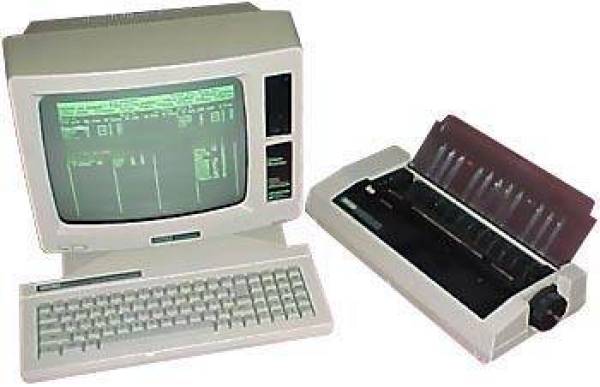
The amstrad PCW 8256, also known as the Schneider Joyce in Germany, was the first model in the PCW family. Like all other models, it features a Z80 processor at 4 MHz and a monochrome screen with a 720 x 256 resolution.
This computer also includes a 3-inch disk drive (180 KB per side) and 256 KB of expandable memory. Additionally, it was delivered with a dot-matrix printer featuring its own proprietary interface, as the computer did not include standard serial or parallel ports.
The system was supplied with a copy of LocoScript, a word processor specifically designed for these computers, as well as a version of CP/M Plus, both developed by Locomotive.
The Amstrad PCW was launched to dominate the small business market by offering a computer, printer, and word processor at a lower price than a typewriter. It gained great acceptance despite the persistence of 3-inch disks (at a time when 3.5-inch / 720 KB disks were becoming the market standard), as Amsoft focused on converting CP/M applications to that format. It became easier to find Dbase II on 3-inch disks than in its native 5.25-inch format; even Microsoft released all its CP/M compilers in that format. Due to the high price of disks, kits soon appeared to connect 5.25-inch (external) and 3.5-inch (external and internal, the latter requiring modifications) drives. Unexpectedly, software houses began releasing games for the PCW, proving that the GSX extension (on which the PC/ST GEM was based) was not only useful for charts and diagrams. The RS232/parallel interface allowed the connection of other printers (some programs began supporting HP laser printers), and PCW users started appearing on BBS. Eventually, hard drive units from 20 to 40 MB became available.
In Germany, Schneider distributed them under the names Joyce and Joyce Plus.
In the USA, it made a brief appearance alongside the PC 1640 but was quickly swept from the market by powerful catalog sales (several liquidations ads were seen). It is possible that USA and German boards have differences compared to the rest of the European versions.
In Spain, the traditional scarcity of peripherals made the use of other printers very costly, causing them to decline as the PC market became cheaper. They disappeared from offices when 9-pin printers were replaced by inkjet printers. For a time, a market for PCW-to-PC file conversion emerged.
Packaging
The outer packaging is a cardboard box. Inside, protected by white polystyrene (styrofoam) against potential impacts, it included: the green phosphor monitor with a built-in 180 KB 3-inch drive, a dot-matrix printer, a keyboard, the manuals (Volume 1: Locoscript, CP/M, and Logo; Volume 2: Mallard Basic), and two 3-inch disks containing the Locoscript word processor, CP/M, Utilities, and Dr. Logo. Some units included promotional software with the purchase; in this case, as seen in the images, the promotion was a pack consisting of Amsfile, Supercalc2, and accounting software.
 |  |  |  |
 |  |  |  |
 |  |  |  |