AMSTRAD PCW 16 / ANNE
Technical Specifications
| Processor | Zilog Z80A at 16 MHz |
|---|---|
| RAM Memory | 1024 Kb expandable to 2048 Kb |
| ROM memory | 1 MB Flash RAM with built-in operating system and software. The first 64 KB store the BIOS; it also stores fonts and templates. |
| Chips | Winbond 83787 I/O chipset co-processor. |
| Graphics | 640×480 pixel resolution in black and white. |
| Sound | 1 Channel. |
| Connections | DB9 serial ports and parallel printer port. DB9 mouse port and PS/2 keyboard port. |
| Internal Storage | One 3.5-inch 1.44 MB floppy disk drive. |
| Monitor | Integrated monochrome monitor. |
| Keyboard | 102-key AT-PC type keyboard. PS/2 compatible keyboard. |
Description
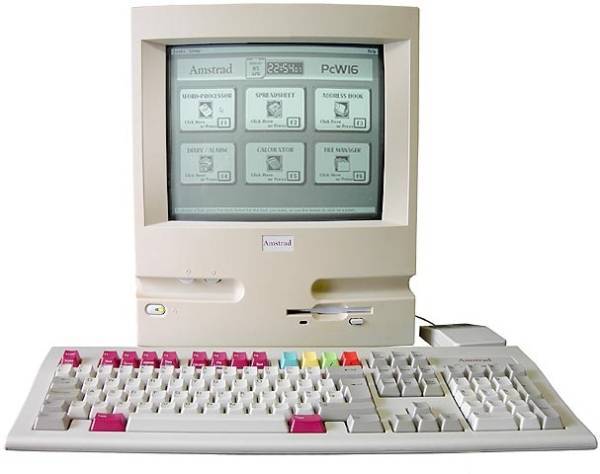
The amstrad PCW 16 or Anne replaced the PCW 9512 in 1996. It was the last of the range and represented a radical change. The Zilog Z80 was retained but clocked at 16 MHz, and the memory consisted of 1024 KB, expandable to 2048 KB. Unlike previous models that used text-based interfaces, the PCW 16 utilized a Graphical User Interface (GUI) called 'Escritorio' (Desktop). The computer did not run CP/M like older PCW machines; instead, it featured its own operating system called “Roseanne”, a GUI written by Creative Technology. This OS, along with its programs, was stored in 1024 KB of Flash RAM. It cannot run software from previous models natively, though it can execute them via ZP/M with the exception of Locoscript and certain games. Although CP/M was not officially supplied, it was adapted for this machine by independent developers. Unlike earlier PCW models that came only with the Locoscript word processor, the PcW16 included a full suite of built-in software: word processor, spreadsheet, address book, diary/alarm, calculator, and file manager. Fortunately, amstrad abandoned the 3-inch Hitachi disk format in favor of the standard 3.5-inch 1.44 MB MS-DOS high-density format, which was also capable of reading the three previous formats. The Roseanne operating system supported long filenames (up to 31 characters). The screen was also standard: 640 x 480 VGA mode. Amstrad planned several internal expansions for the PCW 16—such as 1 MB RAM upgrades, 2 MB Flash RAM, application ROMs, a second floppy drive, modems, and the Psy-Q Development Kit—but it seems none of them were ever released. It did not include a printer as standard but supported any HP, Epson, Canon, or IBM compatible printer, as well as specific supported models.
Screens
 |  |  |
 |  |  |