
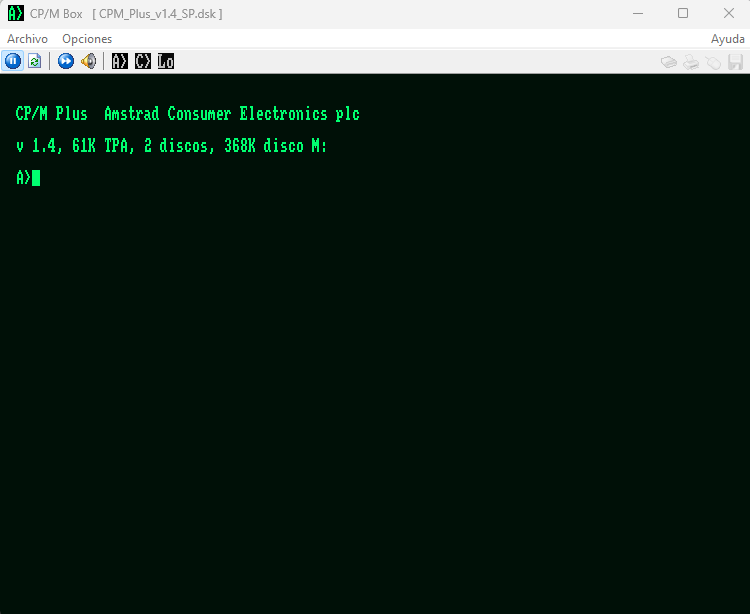
CP/M BOX

CP/M Box is considered by the international community as the "definitive" evolution for modern Amstrad PCW users. Developed by Habi (Habisoft), a key figure and absolute reference in the Amstrad preservation scene in Spain, this emulator combines an intuitive user interface with unprecedented technical power, making a 1985 office machine feel native on 2026 operating systems.
Unlike other projects, CP/M Box was designed with an obsessive focus on cycle-exact fidelity. This means the emulator not only replicates hardware functions but also reproduces the exact temporal behavior of the components, including "bugs" or undocumented behaviors of the original hardware (such as Gate Array particularities). This precision is vital for extremely demanding software titles, such as the isometric games Head over Heels or Batman, or applications with complex disk protections, to function identically to how they did on the real machine.
Among its major documented contributions are:
- Range Versatility and Precision: It is the only emulator capable of covering with mathematical accuracy all manufactured models, from the pioneering 8256 to the elusive and late PcW10, correctly managing differences in disk controllers (765) and read densities.
- Documentary Preservation and LocoScript: It has been the key tool for rescuing thousands of old documents. Its ability to manage disk images (.DSK) transparently and its support for virtual printers allows texts created in LocoScript decades ago to be exported or printed in modern formats without loss of formatting.
- Peripheral Integration and Local Hardware: It has greatly facilitated the user experience by integrating native support for AMX mice and joystick standards (Kempston/Cascade). Furthermore, it faithfully emulates memory expansions and hardware specifically developed in Spain, transforming the PCW into a versatile design and gaming station.
- Standard for Homebrew Development: Thanks to a professional-grade internal debugger and its management of up to 2MB of RAM, it has established itself as the standard testing environment for current scene programmers. In 2026, it remains the tool on which new software releases that keep the PCW legacy alive are tested.
In its most recent versions (specifically from version 1.10.0, released in late 2024 and consolidated in 2025/2026), Habi has integrated an advanced audio system into CP/M Box.
This addition is a significant milestone, as the original Amstrad PCW lacked a dedicated sound chip (it only possessed a small speaker for basic "beeps").
The improvements implemented by Habi allow not only for emulating the original sound but also for expanding the machine's capabilities through virtual hardware:
- Independent Audio Mixer: The emulator now features an audio system that allows for configuring a separate mixer for each voice.
- EMR MIDI Support: One of the major new features in version 1.10.0 is the inclusion of support for EMR MIDI, allowing the PCW to interact with external MIDI devices or synthesizers, a functionality that was historically very limited on this system.
- Detailed Volume Control: The interface includes a master volume control and individual adjustments for each emulated audio source, even allowing stereo mixing for devices that were originally monaural.
- Recording with Audio: The emulator's video recording function now captures both the image and the sound generated by the system in a synchronized manner.
- Audio Filters: Filtering options have been added to improve output quality or simulate the acoustics of old hardware.
This sound support is fundamental for enjoying enhanced versions of classic games. A prominent example is the "Enhanced" version of La Abadía del Crimen (released by Habi in 2024-2025), which includes digitized audio taking advantage of these new emulator capabilities and support for sound hardware clones such as the Dk'sound.
Technical requirements: To enjoy these features, the emulator now requires the host system to have an active audio device and Windows 7 64-bit or higher.