JOYCE EMULATOR

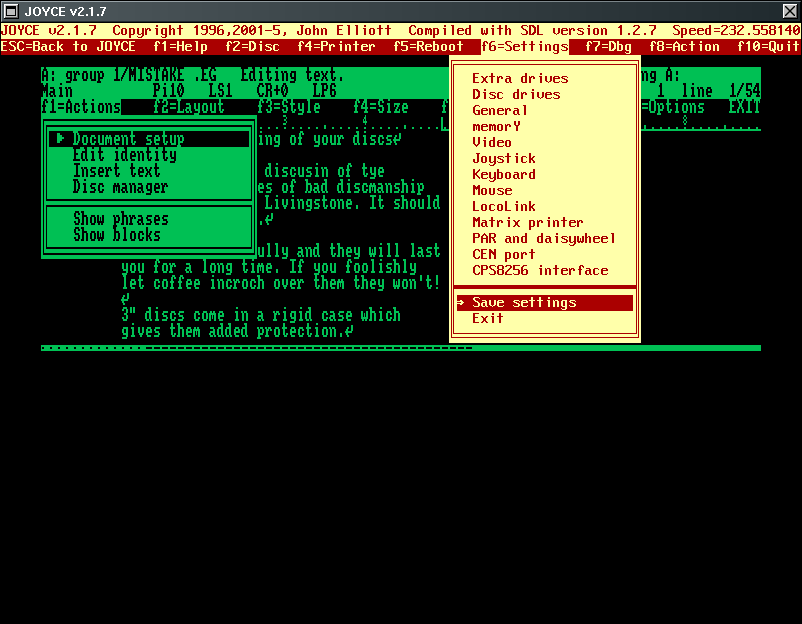
JOYCE stands as the reference emulator and the first to achieve complete maturity and remarkable fidelity for the Amstrad PCW platform. Its development by the British engineer John Elliott, started in the late 90s, marked a milestone in the preservation of this office machine, being the pillar upon which modern emulation of the system rests in 2026.
The philosophy behind JOYCE transcended simple software execution, focusing on replicating the complex input/output (I/O) architecture of the PCW. This academic and rigorous approach allowed critical professional software, such as the LocoScript word processor, to function stably, respecting the timings and behaviors of the original hardware. Unlike other projects, JOYCE focuses on the versatility of the ecosystem, including low-level tools for disk image manipulation and proprietary format conversion, being an essential bridge for the recovery of historical data.
- Multiplatform Compatibility: Originally born in MS-DOS, its evolution and portability to modern systems such as Linux, Windows and macOS through the SDL library has guaranteed its longevity and universal accessibility, being the preferred choice for users outside the Windows environment.
- Peripheral Emulation: It was a pioneer in accurately emulating not only the base hardware (Z80 processor, memory management and 720x256 video), but also complex and essential peripherals such as the Amstrad printer, the PCW Linkit interface and, crucially, the floppy disk system that loads the CP/M Plus operating system from boot, supporting .DSK and .CFI formats.
- Model Versatility and the ANNE Project: It is one of the few emulators that covers the entire range with absolute fidelity (8256 to 9512+). Furthermore, the inclusion of the ANNE module expands its utility to the emulation of the PcW16, a machine with radically different hardware based on Flash memory, consolidating JOYCE as the most complete and technical solution for the entire family of Amstrad office computers.
- Operating System Fidelity: Having been developed in the United Kingdom, it offers perfect compatibility with the various English CP/M Plus versions, ensuring that keyboard mapping and character sets behave exactly as on the original machines.