AMSTRAD PCW ODESSA
The PCW Odessa was manufactured by the company Isenstein; their address was:
Unity Passage, Lower Bridge Street, Chester CH1 1 RY - Telephone: 0244 312986
Technical Specifications
| Processor | Zilog Z80A at 4MHz with wait states. |
|---|---|
| RAM Memory | 256 KB or 512 KB, depending on the base model. RAM Disk 368 Kb. |
| ROM memory | Does not have a boot ROM. |
| Chips | Gate Array designed by Amstrad, uPD765 disk controller. |
| Graphics | 30 lines of 90 characters. |
| Sound | Fixed frequency generator. Internal speaker output (no volume control). |
| Connections | Expansion bus, and connectors for the keyboard and printer (PCW specific). |
| Internal Support | Two 3″ floppy disk drives (180 KB per side). Second unit 720 KB. |
| Monitor | 4-inch green phosphor screen. Size of 10 cm. 90×30. |
| Keyboard | 82 plastic keys in QWERTY/QWERTZ/AZERTY format depending on the country. |
| Price | England: £629 |
Information
How many times did we think about taking our PCW to work, on vacation, etc., to be able to use our word processor? At the time, the only solution was to buy a laptop and link it to the PCW, which was the role of the Z88. The main problem was the compatibility of LocoScript and CP/M, which did not run on other machines.
The widespread acceptance of the PCW in Great Britain led the firm Isenstein Computer Systems to release a portable version of this computer as an alternative solution: the conversion of a modern PCW.
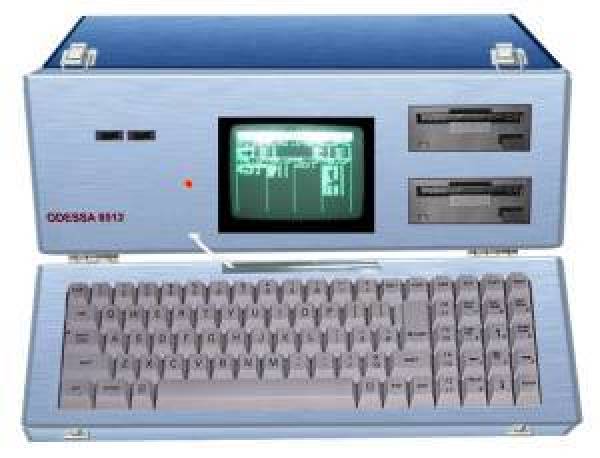
The Amstrad PCW Odessa, distributed by the company Isenstein, was a customized PCW—essentially an 8512 inside a briefcase that included a 4” green phosphor CRT monitor, a disk drive, and a keyboard like that of the PCW. It featured a second drive, the possibility of connecting 5 1/4“ and 3 1/2” units, and four different power options, including a battery service capable of powering it for eight hours. We say it was a customized PCW because you could send your own PCW 8256/8512 to be converted or order the finished product directly.
Therefore, it was fully compatible with any PCW and included the expansion port. It is not known for certain how many of these were converted and how many were put up for sale, but there could not have been many.
In reality, the PCW underwent several transformations, but the Odessa was the best known (a PCW rebuilt into a portable-style briefcase), along with an attempt to create a PCW with an inverted screen for use in a car, which was one of the most ambitious projects (there were images of prototypes, but it never reached the market)..
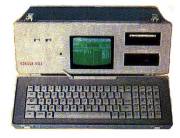
The Odessa is effectively a PCW that has been stripped down and repackaged into a briefcase for transport. Said briefcase was tightly adjusted in size and weight, and consequently, full. It consisted of a motherboard, two 3“ disk drives (the same ones from the PCW 8512), and a repackaged PCW 8000 series keyboard with the same key layout, built into the folding lid of the main unit. The drives and the monitor were located in the upper part of the main unit. The PCW monitor was replaced by a four-inch diagonal (10 cm) mini-TV style screen, displaying 30 lines of 90 characters. It used rechargeable batteries that provided 4 hours of good service, although, as always, in practice, the time was shorter.
The lid could not be closed if the machine was still turned on, so there was no need to worry about the batteries if it were accidentally left on. All internal components were the same as the PCW, meaning it could run the same programs as the 8000 series, such as LocoScript, CP/M, Protext, Mini Office, and Supercalc, among others. This saved time by avoiding modifications or transfer procedures, such as having to get home and use a disk on our PCW; especially when compared to the alternative of using a laptop that did not use CP/M or LocoScript and required transfers via cable and communications software. Despite being supplied with all PCW software, there were certain incompatibilities with the PCW, particularly regarding the keyboard with some software.
An external monitor could be connected, and you could use and work with the same disks as a normal PCW. It featured an expansion port for connecting an RS232 interface or a modem, using the same printer, etc. It performed exactly like a standard PCW.
The Odessa was sold with or without a printer, as this was optional, although nothing prevented using the dot-matrix printer from the PCW 8256/8512. One or two disk drives were also optional (priced at £528 with one drive and £629 with two). Versions with an added parallel/serial interface, which allowed connecting a modem or a daisy-wheel printer, cost an additional £70. If a PCW 8256 or PCW 8512 printer was required, the price increased by £230 and £310 respectively. Prices varied depending on the desired configuration.
Another issue was that if we supplied our own PCW for conversion into an Odessa, the Amstrad warranty would be voided; therefore, the company Isenstein provided its own twelve-month warranty.
It is worth noting that due to its shape and components, it was somewhat heavy to carry.
Images
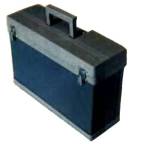
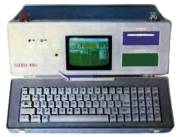
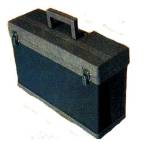
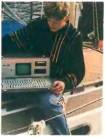
Below are some real images from high-circulation magazines of the era. Here we can see the PCW Odessa carrying case and the unit itself.
 |  |  |  |  |